
Overview
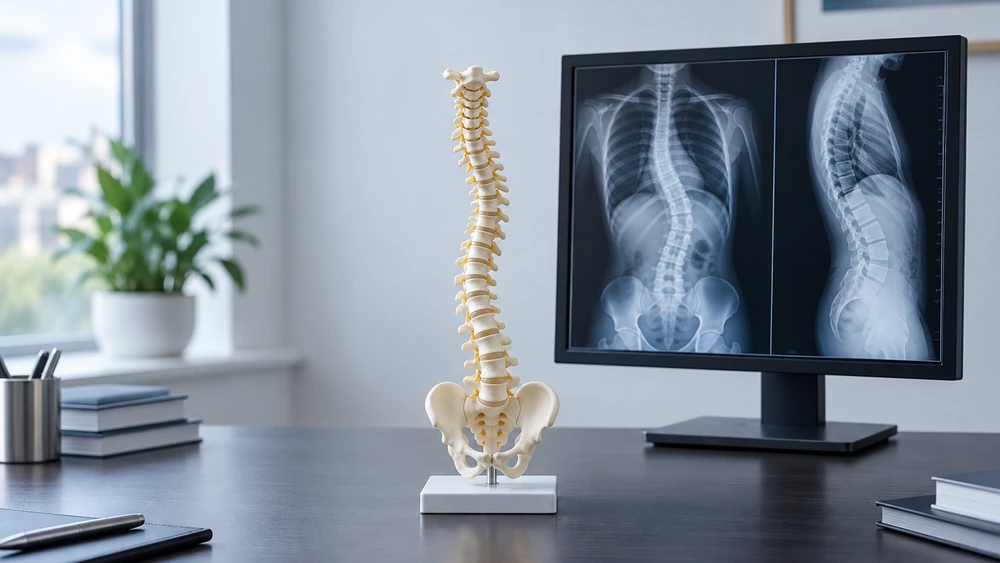
The spine is made up of vertebrae separated by discs and connected by small facet joints. Over time, these structures naturally wear. When wear occurs unevenly, one side of a disc or joint may collapse more than the other, leading to a tilt and rotation in the spine. This produces a curve, most often in the lower back. The medical term for this condition is degenerative or de novo scoliosis, meaning it develops in a spine that was previously straight. It typically begins after the age of 50.
This condition affects roughly 30% of adults over 50 years old, according to recent studies. The curve itself is often not the main problem. Symptoms generally arise because the same degenerative process narrows the spinal canal and nerve spaces, leading to spinal stenosis. Some patients also develop a forward or sideways lean, making it difficult to stand upright.
Management of adult degenerative scoliosis is typically a stepped pathway rather than a single procedure. Most patients start with conservative care. Many are managed successfully without surgery through structured physiotherapy focusing on core stability, hip strength, posture, walking tolerance, activity modification, and pain management. Weight and lifestyle support are also crucial. Bone health assessment is important, as osteoporosis is common in this age group. Image-guided injections can be both diagnostic and therapeutic.
When symptoms remain disabling despite a genuine trial of conservative care, or when there is significant nerve compression or progressive deformity, surgery may be considered. Surgical options can range from decompression alone to short-segment fusion with decompression, or longer deformity correction where imbalance or a progressive curve is prominent.
Who is it for?
Assessment may be beneficial if you recognise several of the following:
- Persistent lower back pain that has changed in character or intensity over recent years.
- Pain, numbness, tingling, or heaviness in one or both legs.
- Difficulty walking any distance, with symptoms eased by sitting or leaning forward on a trolley.
- A noticeable change in posture, such as leaning to one side or stooping forwards.
- Uneven shoulders or hips, or clothes no longer sitting evenly.
- Loss of height, or a feeling that the ribs are dropping towards the pelvis.
- Symptoms that have not responded to physiotherapy, medication, or injections.
It is important to note that not every curve requires intervention. Many adults have mild degenerative curves found incidentally on imaging and remain comfortable for years.
How treatment works
Assessment
A full history and examination, with standing full-length spinal X-rays to show alignment under load, and MRI or CT where nerve compression needs clarifying. Bone health is checked where relevant.
Discussion of options.
Monitoring, physiotherapy, injections and surgery are set out, with the reasoning behind each and the consequences of doing nothing.
Treatment
Where surgery is right, this may be decompression alone, short-segment fusion, or longer correction, chosen to match the problem.
Recovery
Structured rehabilitation follows, with interval X-rays to monitor alignment and healing.
Risks and Honest Expectations
All treatments carry risk, and deformity surgery in older adults carries more than routine spinal procedures. Potential risks include infection, bleeding, blood clots, dural tear and cerebrospinal fluid leak, nerve injury with numbness or weakness, anaesthetic and medical complications, non-union of the fusion, implant loosening or failure, adjacent segment degeneration, and the possibility of further surgery. Ongoing pain or incomplete relief is also possible. Injections and physiotherapy carry lower risks but may provide only partial or temporary relief.
The aim is to reduce leg pain, improve walking distance and standing tolerance, and prevent further deterioration, rather than to achieve a perfectly straight spine. It is realistic to expect improvement, not a return to a pain-free, youthful spine. Leg pain and walking distance generally improve more reliably than back pain, and some stiffness is expected after fusion. Exercise cannot reverse a structural curve, but it can improve strength, balance, walking tolerance and pain, which is often what matters most day to day. Not every curve progresses; some remain stable for years, and progression is monitored with standing X-rays rather than assumed. Age alone is not a barrier to treatment; general health, bone quality, mobility and personal goals matter more.
Surgery is only ever recommended when non-surgical care has been fully explored and it is genuinely the right option.
QUICK FACTS
Typically affects
Adults over 50
First approach
Physiotherapy and injections
Key imaging
Standing full-length X-rays
Anaesthetic
Local & General
Hospital stay
Short after decompression, days after fusion
Recovery
Weeks to months