
Overview
Spinal fusion permanently connects two or more vertebrae to stop abnormal movement that can cause pain or pressure on nerves. This procedure is often performed when conservative treatments have failed.
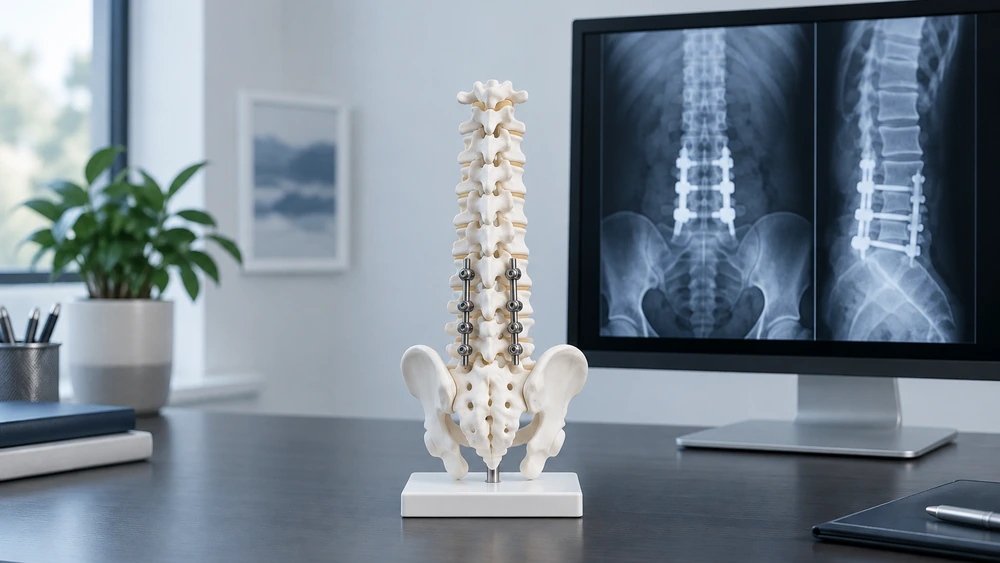
During spinal fusion surgery, the vertebrae surfaces are prepared, and a bone graft or graft substitute is placed between them. Screws, rods, cages, or plates are used to hold the segment steady while healing occurs. Over several months, the bone grows together, functioning as a single unit.
Spinal fusion can be performed in the neck, mid back, or lower back, approached from different angles depending on the diagnosis and individual anatomy. This is a major surgical treatment, recommended only after thorough assessment and discussion of alternatives.
For most spinal conditions, non-surgical care is the first step. This may include activity modification, structured physiotherapy, pain management, weight management, injections, or bracing in children. Both NHS and NICE guidelines endorse conservative treatment as the starting point. Surgery is considered when symptoms are significant, function is impaired, or there is a structural issue unlikely to improve on its own.
Who is a Candidate for Spinal Fusion Surgery?
Spinal fusion surgery is suitable for a relatively small number of people with spinal symptoms. It may be considered if you experience:
- Persistent back or neck pain that has not improved with several months of appropriate non-surgical treatment.
- Leg or arm pain, numbness, pins and needles, or weakness caused by pressure on spinal nerves.
- Pain that worsens with standing or walking and eases when sitting or leaning forwards.
- A spinal curve or deformity that is progressing or affects posture, balance, or breathing.
- Instability following a fracture, infection, tumour, or previous spinal surgery.
- A clear reduction in your ability to work, sleep, exercise, or manage daily activities.
Not everyone with back pain requires or benefits from spinal fusion surgery. Suitability depends on your diagnosis, imaging findings, overall health, bone quality, smoking status, and personal goals.
How the procedure works
Assessment
A full history and examination, with imaging to confirm the level and the underlying problem, and bone health considered where relevant.
Discussion of options
Conservative care, decompression without fusion, and fusion are set out, with the benefits and risks of each.
Fusion
Where fusion is right, the vertebrae are prepared, graft is placed, and the segment is stabilised with implants under general anaesthetic.
Recovery
Walking is encouraged early, with a staged return to activity while the bone fuses over the following months, supported by physiotherapy.
Risks and Honest Expectations
Spinal fusion carries risks that must be weighed against the potential benefits. These include infection, bleeding, blood clots, anaesthetic complications, nerve or blood vessel injury, leakage of spinal fluid, implant-related problems, and failure of the bone to fuse fully. Some patients experience less improvement than hoped, occasionally needing revision surgery.
No spinal operation can guarantee complete pain relief, and some patients continue to need ongoing management. Fusing one or two levels usually has a modest effect on overall flexibility, while longer fusions reduce range of motion more noticeably. Outcomes vary significantly with the underlying diagnosis, which is why patient selection matters so much. Smoking, poorly controlled diabetes, osteoporosis and higher body weight can affect healing, so reducing modifiable risks is often part of the plan. Alternatives such as targeted physiotherapy, injections, pain management or decompression without fusion are always discussed where appropriate.
Surgery is only recommended when non-surgical care has been thoroughly explored and is genuinely the right option.
QUICK FACTS
Procedure time
1 to 2 hours, single level
Anaesthetic
General
Hospital stay
A few days
Walking
Within a day of surgery
Back to desk work
4 to 12 weeks
Full fusion
6 to 12 months